
TL;DR
- According to Gartner, 73% of analytics projects fail to deliver measurable business value. The cause is almost never the technology.
- In 2026, hiring an analytics consultant means vetting for AI governance, agentic workflows, and technical debt remediation, not just SQL and dashboards.
- For most U.S. companies between $10M and $500M in revenue, a boutique specialist outperforms a global firm on speed, senior attention, and cost predictability.
- A single duplicate-record problem in one client marketing database was generating $2.3M in annual waste. The right consultant finds and prices this before the engagement starts.
- The talent gap, not budget, is the primary reason mid-market companies delay this decision. That delay costs more than the engagement.
Quick Answer
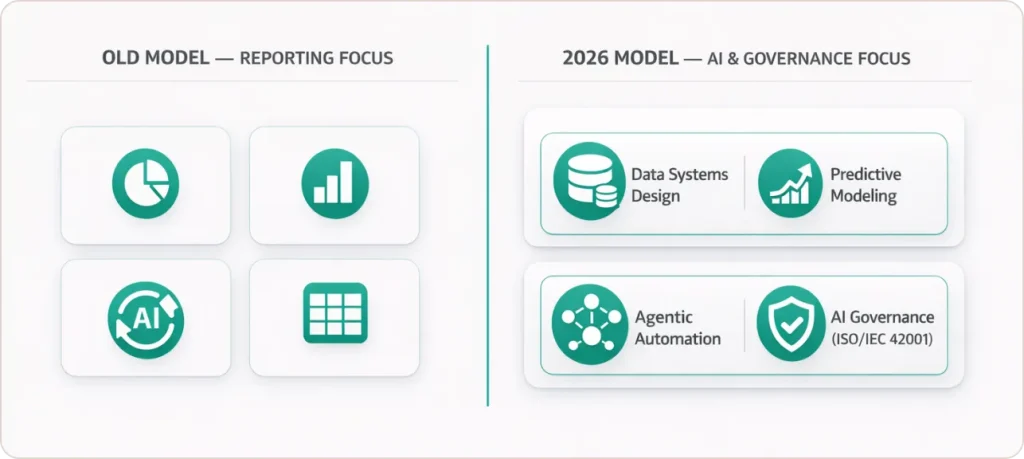
An analytics consultant helps organizations turn raw data into business decisions by designing data systems, building predictive models, and governing AI workflows. In 2026, leading consultants focus on agentic automation, technical debt remediation, and AI governance standards such as ISO/IEC 42001, not just reporting.
I have watched this play out more times than I can count. A company invests six figures into a data analytics engagement, onboards a firm with impressive credentials, and twelve months later, the dashboards are sitting untouched while leadership still runs on gut instinct. The postmortem always reveals the same thing. It was not a technology failure. It was a selection failure.
Choosing the wrong analytics consultant is one of the most expensive decisions a growing U.S. company can quietly make in 2026. IDC estimates there will be approximately 291 zettabytes (ZB) of digital data generated in 2027. The organizations that extract value from that data will not be the ones with the biggest budgets. They will be the ones who hired the right partner to orchestrate decisions, not just build reports.
That distinction is the entire point of this guide.
What Does an Analytics Consultant Actually Do in 2026?
An analytics consultant designs and governs data systems that help organizations make faster, more accurate business decisions. In 2026, this means building agentic AI workflows, remediating technical debt, and translating complex architecture into outcomes a CFO can act on. It is not a reporting role. It is a strategic one.
The role has moved far past dashboards. When I work through failed engagement diagnostics with CDOs, the pattern is consistent: they hired someone who could describe what happened in the data, not someone who could automate what should happen next. That gap between descriptive analytics and autonomous decision workflows is where most consulting value either gets created or gets lost entirely.
The first question to ask any prospective partner: “Walk me through a recent engagement where you built or governed an automated decision workflow.” If they pivot to dashboard screenshots, the conversation is over.
Why Do 73% of Analytics Projects Fail to Deliver Measurable Value?
85% of big data projects fail, according to 2017 Gartner interviews, as analytics projects fail to deliver measurable business value. The causes are almost never technical. After working through dozens of diagnostic engagements, the root causes collapse into three problems every time.
The first is strategic misalignment. The consultant builds what was specified in the statement of work, not what the business actually needs to decide. No discovery process catches this because nobody asked the right questions before the contract was signed.
Gartner (2022 Market Guide for Data Quality Solutions) estimates poor data quality costs $12.9M annually; separate studies show 18–20% of data team time spent on fixes.
The third is governance failure. AI outputs that cannot be audited cannot be trusted at scale. ISO/IEC 42001 is the international management system standard that governs how organizations develop, deploy, and maintain AI responsibly. Organizations that skip a governance framework at the start spend significantly more fixing compliance and accuracy issues after the models are already in production.
All three are preventable. All three start with who you hire and what you contractually require before day one.
How Do You Know Which Type of Analytics Consultant You Need?
The right analytics consultant depends on your role, your data maturity stage, and the specific decision you are trying to automate or accelerate. Most organizations fit one of three profiles, and each profile requires a different engagement model.
Before issuing an RFP or sitting through a vendor demo, identify which of the following describes your situation.
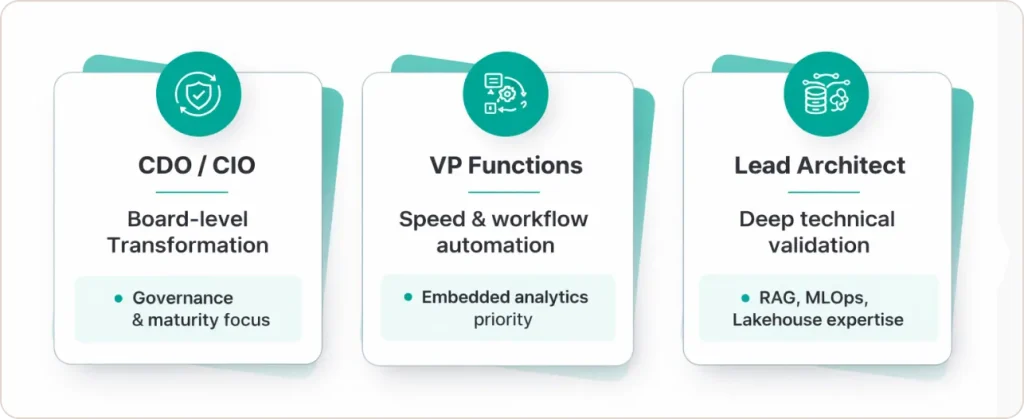
If you are a CDO or CIO driving board-level transformation over 18 to 24 months, you need a partner with demonstrated governance expertise, a structured data maturity framework, and a clear plan for building internal capability rather than long-term dependency. Ask for their governance maturity model and two references from comparable-size engagements. Getting this wrong is measured in years, not quarters.
If you are a VP of Marketing, Operations, or Finance, your problem is almost always speed. Your team spends too much time pulling data and not enough time acting on it. The right data analytics provider embeds analytics directly into existing workflows, automating outputs inside Slack, your CRM, or your planning tools, rather than requiring a separate BI platform that needs a dedicated analyst to operate. Our Business Intelligence Consulting practice is built specifically around this embedded workflow model.
If you are a Lead Architect or Principal Data Engineer, you are the skeptic in the room, and you should be. The firm you select needs to demonstrate real fluency in RAG architecture, vector databases, MLOps pipeline management, and Lakehouse implementations on Databricks or Snowflake Iceberg. Surface-level familiarity with these tools is a liability dressed as a credential. Ask them to describe a production agentic pipeline they have built. Conceptual answers disqualify a vendor.
Knowing your profile before entering vendor conversations eliminates weeks of misaligned pitches and prevents the most common and costly mistake in consulting procurement: buying a solution to the wrong problem.
Global Firm or Boutique Analytics Consultant: Which Delivers Better ROI?
For most mid-market companies, boutique analytics consultants deliver faster ROI, more senior involvement, and lower total cost than global firms. Global firms provide scale and brand credibility essential for Fortune 500 procurement requirements. However, that same scale often disadvantages organizations with revenue below $500M.
Global Firm vs. Boutique Specialist: Side-by-Side Comparison
| Criteria | Global Firms (Deloitte, IBM, Accenture) | Boutique Specialists |
|---|---|---|
| Best For | Fortune 500 enterprise transformation | Mid-market and high-growth organizations |
| Senior Involvement | Seniors sell, juniors deliver | Senior practitioners stay through delivery |
| Tech Stack | Proprietary platforms: Watsonx, SynOps | Open stacks: Snowflake, dbt, Power BI, Databricks |
| Budget Model | Variable, time-and-materials | Milestone-based, predictable |
| Speed to First Insight | 3 to 6 months | 4 to 8 weeks |
| Vendor Lock-in Risk | High (proprietary tooling dependency) | Low (stack-agnostic approach) |
| AI Governance Standard | ISO/IEC 42001 for enterprise contracts | Verify directly during vendor vetting |
| Contract Flexibility | Low | High |
The single most important due diligence step at this stage is finding out who is actually doing the work week to week. Get names, not org charts. Look up delivery team members on LinkedIn before the proposal is signed. The gap between the partner who pitched you and the analyst who shows up on Monday morning is where mid-market companies consistently get hurt.
What Technical Skills Must an Analytics Consultant Demonstrate in 2026?
In 2026, an analytics consultant must demonstrate proficiency in agentic AI workflow design, RAG architecture, Lakehouse implementation, technical debt assessment, and ISO/IEC 42001 governance alignment. SQL proficiency and BI tool experience are baseline expectations, not differentiators.
Use the table below as a live vetting checklist. Bring it into the vendor meeting.
2026 Technical Capability Vetting Checklist
| Capability | Why It Matters | Vetting Question |
|---|---|---|
| Agentic AI Workflow Design | Automates decisions without manual triggers at each step | “Walk me through an agentic pipeline you have built end-to-end.” |
| RAG Architecture | Powers accurate AI responses using your proprietary data | “How do you handle vector database selection for domain-specific LLMs?” |
| Lakehouse Architecture | Unifies structured and unstructured data on one platform | “What is your migration approach from a traditional warehouse to Snowflake Iceberg or Databricks?” |
| Technical Debt Assessment | Surfaces hidden data quality costs before they corrupt model outputs | “Can you run a technical debt audit and price the remediation before the engagement starts?” |
| ISO/IEC 42001 Governance | Required for AI compliance in U.S. enterprise procurement | “How do you document AI system governance for legal and compliance review?” |
| MLOps and Model Monitoring | Keeps predictive models accurate after deployment | “How do you detect and respond to model drift in production environments?” |
A strong data engineering partner will insist on auditing your data foundation before scoping any analytical layer on top of it. If a vendor skips that step and jumps straight to building, you are inheriting their liability.
How Do You Calculate the ROI of an Analytics Consulting Engagement?
The ROI of analytics consulting is calculated by dividing the combined value of improved decisions and operational savings by the total consulting investment. Most mid-market engagements reach payback within 3 to 12 months, depending on scope and starting data maturity.
Run this calculation before any contract is signed.
Analytics ROI = (Value of Improved Decisions + Operational Savings) divided by Total Consulting Investment, multiplied by 100
The formula is simple. Quantifying the numerator is where most procurement teams stall. Here are three benchmarks that produce real numbers.
Time-to-insight reduction: well-executed analytics implementations cut the time business users wait for answers by 40 percent or more. Price that in analyst hours recovered per quarter and you have a hard dollar figure to bring to the CFO.
IT support ticket reduction: self-service analytics consistently drives a 60 to 70 percent drop in analytics-related IT requests within the first 90 days. If your IT team handles 200 analytics tickets per month at a $150 average resolution cost, that is $18,000 per month in recoverable operational capacity.
CRM data quality improvement: A car retailing client detected and removed 12% duplicate contacts. This enhanced direct marketing and sales efforts through a unified database. (Source)
For industry-specific benchmarks and engagement examples, the Retail Analytics and Financial Services pages on this site include before-and-after metrics from comparable engagements.
Is Another Quarter of the Same System Costing More Than the Engagement Would?
The company from the opening of this guide eventually hired the right analytics consultant. It took 18 months longer than it should have. The $2.3 million they could have recovered in misdirected marketing spend was already gone by the time the contract was signed. The data was always there. The decision-making infrastructure was not.
If your organization is still running on exported monthly reports, disconnected BI tools, or analyst-dependent workflows, the cost of staying in that position is compounding every quarter. The gap between data-mature organizations and those still in the planning stage is wider in 2026 than at any point in the last decade. It does not close on its own.