

Key Highlights:
- Chief Data Officers drive 40% faster data initiative completion
- RACI matrices eliminate role confusion in 80% of organizations
- Data Stewards bridge the critical IT-business collaboration gap
- Emerging roles address AI ethics and privacy regulations
- 73% of DIY governance programs fail within 18 months
Introduction
Data governance without clear roles is like a ship with ten captains—everyone’s steering, but nobody’s actually navigating.
I’ve spent over a decade helping organizations untangle their data messes. The number one reason data governance programs fail isn’t technology—it’s people not knowing who’s responsible for what.
Just last quarter, I consulted with a mid-sized SaaS company that invested $200K in a data governance platform. Six months in, adoption was 12%.
The problem? Their VP of Engineering thought the CTO owned data quality. The CTO assumed business units were responsible. Meanwhile, Data Analysts waited for someone to define “clean data.”
The cost? Three months of delayed product launches, two failed compliance audits, and a customer data breach that cost them a $4.2M annual contract.
According to Gartner’s research on data governance, organizations with well-defined data governance roles and responsibilities achieve 30% higher data quality scores and 35% fewer compliance incidents.
Whether you’re building your first data governance framework or fixing one that’s stalled, this is your blueprint for getting the people side right.
Why Clear Data Governance Roles Matter
The Hidden Cost of Role Ambiguity
When data governance roles and responsibilities aren’t clearly defined, chaos follows.
Your marketing team pulls customer data directly from production databases. Your analytics reports contradict each other because three departments define “revenue” differently. Your compliance team discovers GDPR violations six months after they happen.
The real damage is invisible until catastrophic:
- A $180M retail chain lost 18% of their customer base after a data breach traced to unclear access approval responsibilities
- A financial services firm paid $3.7M in CCPA fines because three departments thought someone else owned customer consent management
- A healthcare network spent $890K rebuilding analytics infrastructure after discovering their “single source of truth” was seven conflicting databases
Clear data governance responsibilities aren’t bureaucratic overhead—they’re risk mitigation, efficiency gains, and competitive advantage.
The Business Impact of Getting It Right
When data governance roles are crystal clear, organizations:
- Reduce data quality issues by 60-70% within the first year
- Accelerate analytics projects by 40% because everyone knows who to ask for data access
- Cut compliance audit preparation from 6 weeks to 8 days
- Improve cross-functional collaboration, reducing project friction by 50%
Think of data governance roles and responsibilities as your organization’s operating model for data. The data governance framework you establish becomes the backbone of how your entire organization treats its most valuable assets.
Core Data Governance Roles: Your Essential Starting Lineup
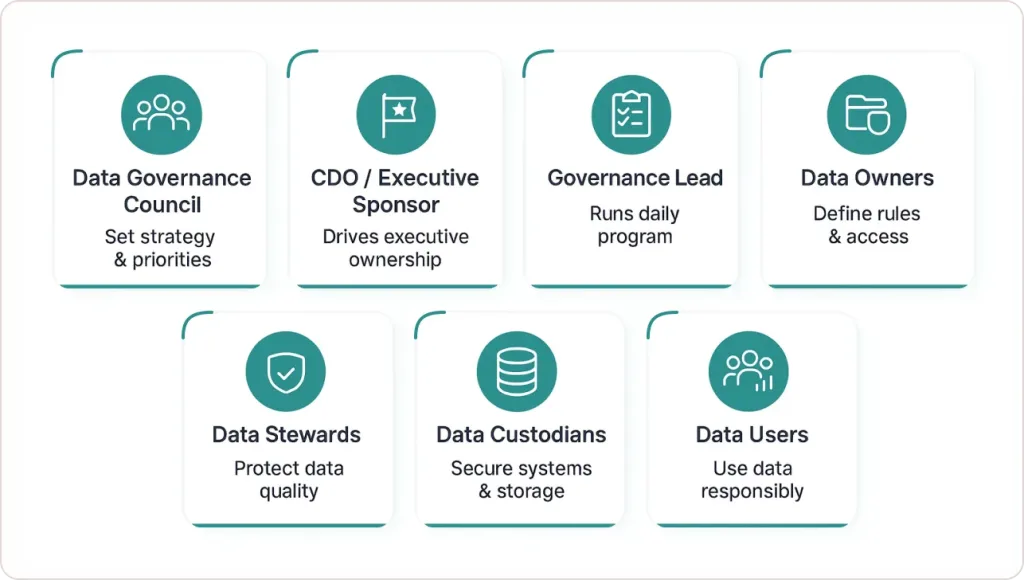
Data Governance Council (Steering Committee)
What They Do: Your governance brain trust—typically C-suite executives and senior department heads who set strategic direction. The Council is the cornerstone of any robust data governance strategy.
Key Responsibilities:
- Define organizational data strategy and vision
- Approve data classification schemes and access policies
- Champion data governance across the organization
- Review KPIs and ensure alignment with business objectives
- Resolve escalated cross-functional conflicts
- Allocate resources for governance initiatives
Effective councils meet quarterly and focus on approving data policies, resolving conflicts, and allocating resources. Pro Tip: Keep this group small—5-7 people max. Larger councils rarely make timely decisions.
Chief Data Officer (CDO) or Data Governance Sponsor
What They Do: Your executive champion—the person with enough clout to break down silos and connect data governance strategy to business outcomes.
Not every organization needs a dedicated CDO. In companies under 500 employees, the CTO or VP of Analytics can serve as executive sponsor. What matters is having executive-level accountability for data governance responsibilities.
Key Responsibilities:
- Own the enterprise data strategy and data governance framework
- Ensure compliance with regulations (GDPR, CCPA, HIPAA)
- Build and champion data-driven culture
- Secure budget (typically 2-4% of IT budget)
- Report data metrics to the board quarterly
- Drive cross-functional alignment on data governance roles
One retail client promoted their Director of Analytics to Chief Data & Analytics Officer to give governance executive voice. Within a year, they consolidated 14 disparate customer databases into a single source of truth.
Data Governance Lead (or Manager)
What They Do: If the CDO is the architect, the Governance Lead is the general contractor who operationalizes the data governance strategy.
This role is hands-on: facilitating meetings, tracking compliance, updating documentation, training stewards, and keeping everyone aligned.
Key Responsibilities:
- Implement and maintain governance policies within the data governance framework
- Coordinate across data stewards and business units
- Develop training programs and documentation
- Monitor governance KPIs (data quality scores, policy compliance rates)
- Escalate issues to the Governance Council with recommendations
- Manage the governance tools ecosystem
Reality Check: This is a full-time role for any organization over 300 employees. Companies that try to make it a “20% role” consistently fail.
The Governance Lead spends significant time on politics and persuasion (30%), documentation and training (25%), tool management and metrics (20%), escalation management (15%), and strategic planning (10%).
Data Owners
What They Do: Senior business stakeholders who own specific data domains. Think “Head of Sales owns customer contact data” or “VP of Finance owns financial transaction data.”
This is business accountability, not technical ownership. When I help clients assign Data Owners, I ask: “If there’s a data quality issue, who should be woken up at 2 AM?”
Key Responsibilities:
- Define business rules and data requirements for their domain
- Approve or deny data access requests (SLA: 48 hours)
- Set data quality standards and acceptable thresholds
- Make decisions about data usage and sharing
- Own compliance for their data domain
- Align domain objectives with overall data governance strategy
Common Mistake: Assigning IT leaders as Data Owners is wrong. The DAMA-DMBOK framework emphasizes that Data Owners must be business leaders who understand how data drives business decisions.
Data Stewards
What They Do: Your data quality champions—operational experts who ensure data meets the standards Data Owners set. These essential data governance roles bridge business and technical teams.
Domain experts (like Senior Marketing Analysts) typically dedicate 20-40% of their time to stewardship, executing critical data governance responsibilities daily.
Key Responsibilities:
- Enforce data quality standards and resolve issues (expect 5-15 tickets weekly)
- Document data definitions and maintain business glossaries
- Manage metadata and data lineage documentation
- Train data users through monthly sessions
- Monitor adherence to the data governance framework
- Conduct periodic data quality audits
Success Formula: Effective Data Stewards spend:
- 40% on proactive quality monitoring
- 30% on reactive issue resolution
- 20% on documentation and training
- 10% on governance evolution
At a $180M e-commerce company, we equipped Data Stewards with Power BI dashboards showing real-time quality metrics. Quality scores improved 43% in six months.
Critical Point: You must free up 20-30% of their time and include stewardship in performance reviews. Otherwise, it’s the first thing dropped when they get busy.
Data Custodians
What They Do: IT and technical teams—database administrators, data engineers, infrastructure teams—who manage physical and technical aspects of data storage and security.
They don’t decide what data to collect or how it’s used, but ensure it’s stored securely and accessible according to the data governance framework.
Key Responsibilities:
- Manage data storage, databases, and infrastructure
- Implement technical security controls and access management
- Execute backup and recovery procedures
- Ensure system performance and availability
- Implement data retention and archival policies
- Translate data governance strategy into technical implementations
The Critical Handoff: The relationship between Data Custodians and Data Owners is where most governance programs break.
Working Model: Data Owner requests real-time sales data. Data Custodian explains options: “Streaming (4-week build) or micro-batch every 15 minutes (1-week build). Here are trade-offs and costs.” Data Owner approves micro-batch. Custodian implements within SLA.
Clear data governance responsibilities, defined communication protocols, and mutual respect are essential.
Data Users (Data Consumers)
What They Do: Everyone who uses data—analysts, marketers, executives, customer service reps, and increasingly, AI systems.
Users have data governance responsibilities too. They’re the last line of defense against bad data propagating through your organization.
Key Responsibilities:
- Follow data access and usage policies
- Report data quality issues when discovered
- Protect sensitive data according to classification
- Complete required annual training
- Never create shadow IT data sources without approval
- Participate in data quality improvement initiatives
Making This Work: We created a “Data Quality Heroes” program where users who reported 5+ legitimate issues got recognition and a small bonus. Data quality reports increased 300%.
We also implemented a Slack bot: /dataquality [issue] automatically routed to the appropriate Data Steward. Reporting jumped from 8-12 issues monthly to 45-60, but resolution time dropped from 6 days to 2 days.
Emerging Data Governance Roles You Should Know
The data governance roles landscape is evolving rapidly. If you’re operating with a 2015-era role structure, you’re exposed to risks that didn’t exist five years ago.
Data Product Manager
Why This Matters: As organizations shift toward data mesh architectures, someone needs to own the “product management” of data assets. This role enhances data governance strategy by bringing product thinking to data management.
Key Responsibilities:
- Define data product strategy and roadmap
- Set and monitor data SLAs (freshness, quality, availability)
- Prioritize improvements based on business value
- Measure data product adoption
- Ensure alignment with the data governance framework
When You Need This: If you have multiple teams consuming the same datasets, competing priorities for data engineering, or data initiatives failing due to poor adoption.
Data Privacy Officer (or Data Protection Officer)
Why This Matters: GDPR made this role mandatory for many EU organizations, but privacy regulations are spreading globally (CCPA, LGPD, PIPEDA).
According to the International Association of Privacy Professionals, organizations subject to GDPR must appoint a Data Protection Officer under specific circumstances.
Key Responsibilities:
- Ensure compliance with privacy regulations across jurisdictions
- Conduct privacy impact assessments for new initiatives
- Manage data subject rights requests (access, deletion, portability)
- Train organization on privacy requirements
- Integrate privacy into data governance strategy
One healthcare client received 340 privacy requests in their first year post-GDPR. Their Privacy Officer built an automated triage system that reduced response time from 28 days to 9 days.
Investment Reality: For organizations with 1000+ employees or handling sensitive personal data, budget $150K-$250K annually for a dedicated Privacy Officer plus tools.
AI Governance Lead
Why This Matters: With AI embedded in hiring, lending, and medical decisions, someone must ensure models don’t perpetuate bias or violate privacy. This is one of the newest data governance roles emerging across industries.
Key Responsibilities:
- Develop AI ethics frameworks and guidelines
- Review AI models for bias and fairness before production deployment
- Ensure AI explainability and transparency
- Manage AI risk assessments
- Establish AI model monitoring procedures
A financial services client deployed a loan approval AI that denied loans to qualified applicants in specific zip codes—a proxy for racial discrimination. They caught it in testing only because an AI Governance Lead implemented bias testing protocols.
Critical Success Factor: This role needs authority to block AI deployments that fail governance criteria.
Why 73% of DIY Data Governance Programs Fail
Here’s the uncomfortable truth: defining data governance roles is the easy part. Making them work is where most organizations fail.
The data governance framework looks great on PowerPoint. RACI matrices are technically correct. Roles are assigned to qualified people. And then… nothing happens.
The Three Failure Patterns
Failure Pattern #1: The “Paper Tiger” Program
You’ve assigned all data governance roles and responsibilities. You have documented policies. But when someone needs urgent data access, they bypass the system entirely.
Why It Happens: Data governance roles have responsibility without authority. Governance requires executive backing that’s demonstrated, not just stated.
Failure Pattern #2: The “Analysis Paralysis” Trap
You spend 6 months designing the perfect data governance framework with 12 role types, sub-committees, and 847 policies. Then adoption is zero.
Why It Happens: You’ve optimized for completeness, not adoption. The governance overhead exceeds perceived value.
Failure Pattern #3: The “Missing the Real Problem”
You’ve defined formal data governance roles, but haven’t mapped informal power structures. Everyone knows you need approval from the 15-year veteran Director, not the official Data Owner.
Why It Happens: Organizations chart data governance roles based on org charts, not actual decision-making authority. 60% of organizations have gaps between formal authority and actual power.
When You Need Expert Help
DIY becomes dangerous when you operate in highly regulated industries, have distributed operations with complex compliance, need to fix governance while keeping business running, or face significant political resistance to data governance roles.
At SR Analytics, we implement data governance programs by mapping informal power structures, building political coalitions, designing adoption strategies, creating measurement frameworks, and bringing pattern recognition from 50+ implementations.
Assigning Roles: Practical Frameworks
The SR Analytics Role Sizing Framework
After implementing 40+ governance programs, we’ve developed a framework accounting for organization size, regulatory intensity, data maturity, geographic distribution, and data architecture.
Organization Size & Complexity
| Size | Employees | Core Roles | Annual Budget |
|---|---|---|---|
| Small | <100 | 3-4 | $50K-$150K |
| Mid-Size | 100-1000 | 6-10 | $200K-$500K |
| Large | 1000-5000 | 12-25 | $600K-$1.5M |
| Enterprise | 5000+ | 30+ | $2M+ |
Additional Factors: High-regulation industries need 30-40% more data governance roles. Organizations at maturity level 1-2 should start with 3-5 core roles. Global organizations need regional leads. Modern architectures require different data governance roles.
Using RACI to Eliminate Confusion
For major data governance activities, define:
- Responsible (does the work)
- Accountable (owns the outcome, one person only)
- Consulted (provides input)
- Informed (kept in the loop)
This clarifies data governance responsibilities and prevents the “that’s not my job” syndrome.
Sample RACI: “Defining Data Quality Rules”
| Activity | Data Owner | Data Steward | Custodian | Lead | CDO |
|---|---|---|---|---|---|
| Define business rules | A | R | C | C | I |
| Implement checks | I | C | R | I | I |
| Monitor compliance | C | A/R | C | C | I |
| Report to executives | I | C | I | C | A/R |
Pro Tips: Focus on 10-15 most critical activities. Only one ‘A’ per row. Review quarterly. Make it accessible.
Best Practices from the Trenches
Start Small, Scale Deliberately
Every failed governance program tried to boil the ocean. They defined 37 data governance roles, wrote 200 pages of policy, and mandated enterprise-wide compliance on day one.
The 90-Day Pilot Approach:
Month 1: Select one critical data domain. Assign 3-4 core data governance roles. Document 5-10 essential policies. Set up basic tools.
Month 2: Run the pilot with full rigor. Collect feedback weekly. Track metrics religiously. Iterate rapidly.
Month 3: Measure business outcomes. Document lessons learned. Identify champions. Plan next domain rollout.
A manufacturing client started with production data and four roles. Results after 90 days: Production data quality 67% → 91%. Time to resolve issues: 12 days → 3 days. User satisfaction: 2.8/5 → 4.2/5.
The CFO saw results and requested governance for financial data immediately. By month 12, they had enterprise-wide governance with 28 role holders.
Make Accountability Visible and Measurable
Define 3-5 KPIs per role to track data governance responsibilities.
Data Owner KPIs:
- % of access requests reviewed within SLA (target: 90%+ within 48 hours)
- % of datasets with documented business rules (target: 100%)
- Data quality score for owned domain (target: 85%+)
Data Steward KPIs:
- Data quality score (target: 85%+)
- % of definitions documented (target: 95%+)
- Average time to resolve issues (target: <3 days)
One healthcare client added data quality scores to quarterly bonus calculations—quality improved 40% in six months.
According to MIT Sloan Management Review research, organizations that tie governance metrics to performance incentives see 3x faster adoption.
Invest in Training
Most organizations announce data governance roles, send an email, and wonder why nothing changes.
Effective Training: Role-specific training (4-12 hours depending on role). General awareness training (mandatory annually). Executive briefings (quarterly).
Format Matters: 15-minute microlearning videos. Monthly brown bag lunches. Interactive workshops. Just-in-time training embedded in tools.
A financial services client created a “Data Governance Academy” with 12 microlearning modules, quarterly workshops, and certification levels. Training completion went from 43% to 92%. Governance incidents dropped 58%.
Avoid “Governance Theater”
Governance theater means programs that look good on paper but accomplish nothing. Warning signs: Policies written but never enforced. Meetings scheduled but decisions deferred. Metrics collected but never reviewed.
Real governance has teeth. It means sometimes saying “no” to access requests, blocking dashboard launches due to quality issues, or requiring project pauses for privacy assessments.
If your data governance framework hasn’t blocked something or required behavior change—you’re doing theater, not governance.
Common Pitfalls and Solutions
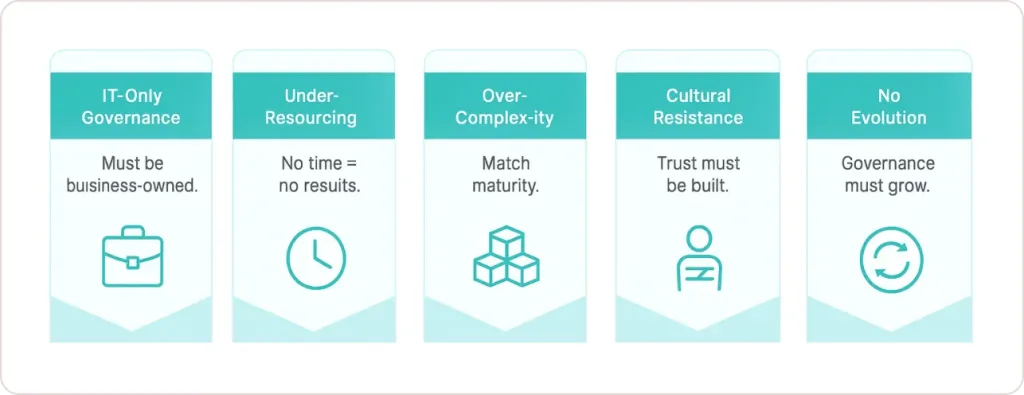
Pitfall #1: Treating Governance as an IT Project – Data governance strategy is a business capability. Business leaders must chair councils. Data Owners must come from business units. Success metrics must tie to business outcomes.
Pitfall #2: Under-Resourcing Roles – Announcing data governance responsibilities without freeing up 20-30% of time guarantees failure. Formally adjust job responsibilities. Include governance in performance reviews. Budget for tools and training.
Pitfall #3: Over-Complicating for Maturity Level – If you’re at maturity level 1, don’t implement a level 4 data governance framework. Match roles to your actual maturity. Start with 3-5 core roles and expand as you prove value.
Pitfall #4: Ignoring Cultural Resistance – Some leaders will resist data governance responsibilities. Identify resisters early. Get executive sponsors to personally engage. Frame governance as enabling success, not constraining it.
Pitfall #5: Failing to Evolve – Your data governance roles and responsibilities should evolve as your organization matures. Conduct annual governance reviews. Monitor regulatory changes quarterly. Pilot new approaches before enterprise rollout.
Conclusion
Getting data governance roles and responsibilities right transforms programs from corporate wallpaper into business value drivers. Start with clarity on who owns what, who does what, and who’s accountable when things go wrong.
The most successful data governance strategy starts with people, not technology. Define data governance roles clearly, document data governance responsibilities explicitly, and measure outcomes relentlessly. Done right, data governance becomes a competitive advantage that drives growth, reduces risk, and enables analytics-driven decision-making.
At SR Analytics, we’ve helped dozens of organizations implement data governance frameworks that actually work, bringing 50,000+ hours of experience to navigate complexities and build frameworks that succeed.