

TL;DR
- Poor data quality costs organizations $12.9 million annually – systematic governance reduces this risk through clear policies
- Pilot-first approaches succeed 4x more often than enterprise-wide rollouts, according to Forrester Research
- Implementation timeline: 3-6 months for pilot, 12-18 months for measurable enterprise ROI
- Critical success factor: Governance is 80% people/culture, 20% technology
What Is a Data Governance Strategy and Why Does It Matter in 2026?
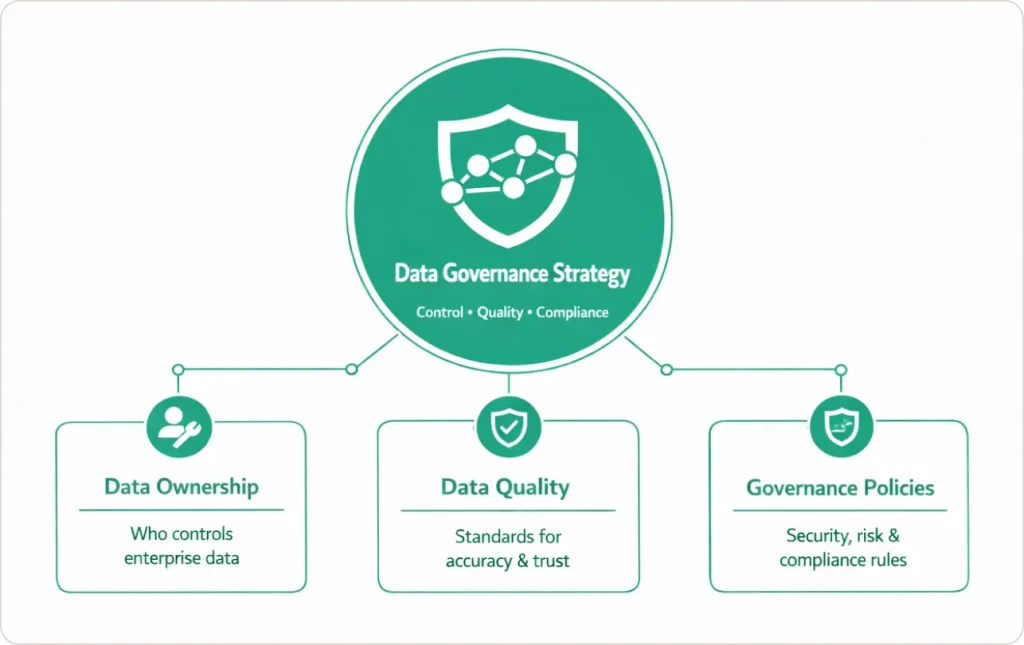
A data governance strategy is your organization’s systematic approach to managing data as a strategic asset. It answers three critical questions: Who owns our data? What quality standards must we meet? How do we balance access with security?
Last month, a Series B fintech company paid $2.3 million in GDPR fines because nobody could answer “Where does customer data live in our systems?” That’s not a compliance failure – it’s a governance failure.
The 2026 landscape makes this approach non-negotiable:
Generative AI demands trusted data. According to Gartner’s 2024 Data & Analytics research, 73% of AI projects fail due to data quality and governance issues, not algorithms. Your LLMs will amplify whatever biases and errors exist in your training data.
Privacy regulations are expanding. The International Association of Privacy Professionals (IAPP) tracks 137 active data privacy laws globally as of February 2026 – up from 89 in 2023. California’s CPRA, Virginia’s CDPA, and similar state laws create compliance complexity requiring systematic approaches.
Poor data quality has quantifiable costs. IBM research pegs annual losses at $12.9 million for the average enterprise. Well-executed governance directly reduces this through quality controls and accountability.
But here’s what separates success from failure: governance isn’t a project with an end date. It’s an operating capability that adapts as your business evolves.
Quick Answer
A data governance strategy establishes who controls your organization’s data, what quality standards apply, and which policies ensure compliance while enabling business decisions and AI capabilities.
Why Do Most Data Governance Initiatives Fail?
Before I walk you through how to implement data governance, let’s address why two-thirds of programs fail within 18 months (according to Forrester’s Data Governance Playbook 2024):
They treat governance as an IT initiative. I watched a $8B retailer spend 18 months building a data dictionary that Sales and Marketing never opened because they weren’t involved in defining what “active customer” meant. When this work lives exclusively in IT, business teams view it as bureaucratic overhead.
They lack C-level sponsorship. Without a Chief Data Officer or executive champion, you can’t enforce accountability across departments. Mid-level managers cannot force Finance and Marketing to agree on revenue definitions.
They attempt enterprise-wide rollouts immediately. Organizations trying to govern all data domains simultaneously get paralyzed by complexity. Successful programs start with one high-value pilot, learn, iterate, then scale.
They ignore organizational change management. You can have perfect policies and technology, but if people don’t understand why this matters, they’ll circumvent it. Implementing data governance is 80% people and culture, 20% technology.
The 7-step data governance strategy framework below addresses each failure mode directly.
Step 1: How Do You Align Your Data Governance Strategy with Business Objectives?
Every successful program starts by connecting data problems to business outcomes executives care about.
Map Business Priorities to Data Challenges
Ask leadership: “What are our top 3 business priorities this year?”
For each priority, identify the data barrier blocking success:
Business Goal: Reduce customer churn by 15%
Data Challenges:
- Customer interactions scattered across Zendesk, Salesforce, Intercom, email
- No unified health scoring methodology
- Seven different definitions of “active customer”
- No data lineage showing how churn models calculate risk
Set SMART Goals
Don’t write vague objectives. Your data governance strategy and roadmap need measurable targets:
Bad goal: “Improve data quality”
Good goal: “Reduce customer record duplicates from 34,000 to under 500 by Q3 2026, enabling single customer view and reducing sales cycle time by 23%”
Quantify ROI
A healthcare system I worked with in 2024 framed its entire approach around reducing claim denials. By improving patient record accuracy and ensuring consistent medical coding, they reduced denials by 22% – directly adding $4.3 million to revenue.
That’s the language CFOs understand. Your governance framework must connect to P&L impact, not just compliance.
Step 2: How Do You Identify and Inventory Your Data Assets?
You cannot govern what you don’t know exists. This discovery phase reveals data sprawl is most organizations’ biggest understatement by 10x.
Catalog Every Data Source
Your comprehensive scan should capture:
- Structured databases – Snowflake, BigQuery, Redshift, PostgreSQL
- SaaS applications – Salesforce, HubSpot, Zendesk, NetSuite
- File storage – SharePoint, Google Drive, S3 buckets
- Unstructured data – Emails, PDFs, contracts, call recordings
- Real-time streams – IoT sensors, application logs, clickstream
Data governance strategy example: JPMorgan Chase’s 2018 catalog initiative required 14 months and 12 dedicated stewards to map 50,000 data assets. They discovered “customer” was defined 23 different ways with zero reconciliation.
Classify by Sensitivity and Value
Your approach should prioritize based on risk:
| Classification | Examples | Controls |
|---|---|---|
| Critical-Sensitive | SSN, payment data, PHI | Encryption, MFA, strict access, audit logging |
| Business-Confidential | Product roadmaps, contracts | Role-based access, quarterly reviews |
| Internal Use | Sales pipeline, metrics | Departmental access |
Map Data Lineage
Data lineage shows the complete journey: origin, transformations, and consumption points.
Why this matters for governance:
- Root cause analysis – When dashboards show conflicting revenue, trace back to find calculation divergence
- Impact assessment – Before schema changes, understand which reports and ML models break
- Regulatory compliance – GDPR Article 30 requires documented processing activities
- AI governance – Model explainability demands knowing which data trained each algorithm
Modern catalogs like Alation, Collibra, or open-source DataHub automate discovery through metadata crawling.
Step 3: Define Governance Roles and Accountability
Effective programs fail when everybody is responsible, which means nobody is accountable.
Establish a Data Governance Council
Your steering committee needs authority to enforce decisions:
- Executive Sponsor – CDO or CIO with budget authority
- Domain Representatives – VP-level leaders from Finance, Sales, Marketing, Operations
- Compliance & Legal – Translates regulations into policies
- Data Platform Leadership – Ensures technical feasibility
The Council meets monthly to review metrics, approve policy changes, and prioritize initiatives.
Assign Data Owners and Stewards
Data Owners are business executives accountable for specific domains:
- VP of Sales owns customer data
- CFO owns financial data
- CMO owns marketing analytics
Data Stewards are tactical executors who:
- Monitor quality metrics and investigate anomalies
- Document business metadata
- Enforce policies in daily operations
- Bridge business teams and data platforms
Build a Data-Driven Culture
According to Google Cloud’s governance best practices, technical implementation is straightforward. Cultural adoption determines success.
Tactics that work:
Create positive incentives. A Fortune 500 retailer launched “Data Quality Champions” badges for stewards maintaining 98%+ accuracy. Public recognition drove 156% increase in issue resolution speed.
Run alignment workshops. When Sales defines “qualified lead” differently than Marketing, pipeline metrics are meaningless. Bring stakeholders together to agree on shared definitions.
Broadcast wins. When governance enables new capabilities or prevents disasters, communicate it company-wide.
One SaaS company reframed messaging from “you can’t access this data” to “we’re ensuring you get accurate data in under 4 hours.” That narrative shift doubled engagement in six months.
Step 4: Develop Policies, Standards, and Framework
Your governance framework transforms from concept to reality through explicit, enforceable policies.
Essential Policy Categories
Data Access Control Policy
- Role-based provisioning (who can access what)
- Approval workflows for elevated privileges
- MFA requirements for sensitive data
- Quarterly access recertification
Data Quality Standards
- Accuracy thresholds by domain (98%+ valid email addresses)
- Completeness requirements (all transactions need timestamp, amount, user ID)
- Timeliness SLAs (sales data refreshed daily by 6 AM)
- Consistency rules (ISO 8601 dates, standardized state codes)
Data Retention and Deletion
- Retention periods aligned with legal requirements
- Archival procedures for aging data
- Automated purging past retention dates
- Legal hold exceptions
Privacy and Security
- PII handling per GDPR and CCPA
- Encryption mandates (at rest and in transit)
- Data subject rights procedures (access, deletion, portability)
- 72-hour breach notification protocols
Master Data Management
- System of record designation (which system is authoritative)
- Golden record creation standards
- Conflict resolution when sources disagree
Choose the Right Governance Model for Your Organization
| Model | Best For | Pros | Cons |
|---|---|---|---|
| Centralized | <1,000 employees | Consistency, easier enforcement | Bottlenecks, doesn’t scale |
| Federated | 5,000+ employees | Scales well, domain expertise | Risk of inconsistency |
| Hybrid | 1,000-5,000 employees | Balance of consistency and flexibility | Boundary management complexity |
Leverage Proven Frameworks
Industry frameworks accelerate your implementation:
- DAMA-DMBOK – Comprehensive reference for all governance areas
- COBIT – IT governance framework with data components
- DCAM – Financial services maturity model
I’ve never seen successful implementation that adopted frameworks wholesale. Extract 20-30% that’s relevant, customize to your context, and start with policies addressing your biggest risks.
Step 5: Implement Through Tools and Processes
This is where data strategy and governance shift from documentation to operational reality.
Start with a Focused Pilot
Organizations starting with targeted pilots succeed 4x more often than enterprise-wide rollouts (Forrester).
Effective pilot criteria:
- High impact – Addresses painful executive problem
- Manageable scope – One data domain or business process
- Visible results – Success measurable within 90 days
- Representative complexity – Tests your model without getting stuck
Successful pilot examples:
- SaaS company eliminated 47,000 duplicate customer records, reducing sales cycle 23%
- Healthcare system governed patient demographics, cutting claim denials 22%
- Financial firm met BCBS 239 requirements, avoiding regulatory fines
Essential Tool Categories
Data Catalogs – Centralize metadata, enable discovery, track lineage
- For <500 employees: Atlan free tier or open-source DataHub
- For enterprises: Alation, Collibra
Data Quality Monitoring – Detect anomalies, enforce validation
- Great Expectations (open-source), Monte Carlo, Informatica
Master Data Management – Create golden records
- Profisee (mid-market), Reltio (cloud-native), Informatica (enterprise)
Access & Privacy – Enforce policies, manage consent
- Immuta, BigID, OneTrust
Embed Governance into Workflows
Don’t treat governance as separate from daily work.
Integration patterns:
- Build quality checks into ETL pipelines – reject invalid data at ingestion
- Enforce access controls in BI layer – users see only authorized data automatically
- Integrate catalogs with analysis tools – search without context switching
- Automate routine requests – self-service based on role
Train Your Teams
Role-specific training:
- Executives (60 min) – Strategy overview, accountability, dashboard interpretation
- Data Owners (half day) – Policy-setting, approval workflows, quality metrics
- Stewards (full day) – Hands-on catalog training, quality monitoring, metadata documentation
- End Users (15 min) – Just-in-time embedded training
A regional bank made catalog training mandatory for data access requests. Their 15-minute module increased policy compliance from 34% to 91% in one quarter.
Step 6: Monitor, Measure, and Continuously Improve
Effective governance is not a project – it’s an operational capability you continuously improve.
Define Measurable KPIs
Data Quality Metrics
- Accuracy rate: 95%+ for critical domains
- Completeness: 98%+ for master data
- Timeliness: <4 hours for operational data
- Duplicate rate: <0.5%
Access & Security Metrics
- Access request time: <4 hours for standard requests
- Approval rate: 70-80% (too high = overly permissive; too low = unrealistic policies)
- Policy exception rate: <20%
- Orphaned access: <5% (users with access but zero usage in 90 days)
Adoption Metrics
- Metadata coverage: 90%+ assets documented
- Catalog usage: 50%+ of data workers monthly
- Self-service enablement: 60%+ requests fulfilled without IT
Business Impact
- Time-to-insight reduction
- Data incidents: 75% reduction year-over-year
- Compliance audit findings: zero critical
- Cost avoidance and revenue impact
Critical metric: Policy exception rate. If you’re approving 80%+ of exceptions, your policies are unrealistic and need revision.
Conduct Regular Audits
Quarterly reviews:
- Access recertification – Data Owners review and revoke unnecessary permissions
- Policy compliance spot checks
- Quality metric investigation for degraded domains
- Metadata accuracy verification
Annual maturity assessments: Benchmark against DAMA or DCAM frameworks to identify gaps and prioritize improvements.
Build Feedback Loops
Policy exception analysis. When the same exception gets requested repeatedly, your policy needs revision.
Business change triggers. New product? Acquisition? AI initiative? Each creates implications requiring governance review.
User satisfaction surveys. Quarterly pulse checks:
- Can you find needed data? (<70% = catalog adoption problem)
- Do you trust data quality? (<80% = quality controls failing)
- Is access request process reasonable? (<60% = friction driving shadow IT)
A Fortune 500 retailer runs quarterly “governance retrospectives” where stewards share what’s working and what’s broken. Policy changes from these sessions achieve 2x higher adoption than top-down mandates.
Step 7: Prepare for AI and Future Needs
Generative AI and LLMs fundamentally changed what governance must address.
Govern Data for AI/ML
Gartner research shows 73% of AI failures stem from data governance issues, not algorithms.
Your framework must address:
Training Data Quality
- Representativeness – does data reflect real-world diversity or amplify bias?
- Provenance tracking – document exactly which data trained each model
- Bias monitoring – test for disparate impact across demographics
- Data drift detection – monitor when production diverges from training distributions
AI Model Metadata
- Track datasets, transformations, and features producing each model
- Version control for models AND training data
- Document assumptions, limitations, failure modes
- Lineage from raw data → features → model → predictions → decisions
Access Controls for AI
- Who can use generative AI tools with company data?
- What data can be sent to external APIs?
- How to prevent sensitive data leakage through AI interfaces?
Responsible AI Policies
- Ethical guidelines for appropriate AI use
- Human-in-the-loop requirements for high-stakes decisions
- Explainability standards
- AI incident response procedures
Implementation example: A financial services firm built AI-specific policies requiring documented lineage for credit scoring models, quarterly bias testing, human review for decisions >$50K, and PII restrictions on LLM prompts.
Adapt to Privacy Regulations
Your approach must be regulation-agile:
Requirements:
- Centralized PII registry across all systems
- Automated data subject request fulfillment (30-day SLA)
- Legislative monitoring process
- Data minimization by default
Build Your Roadmap
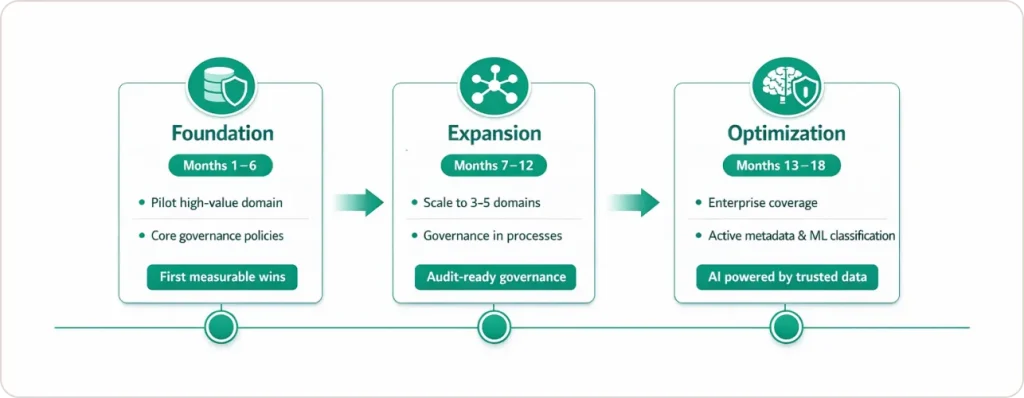
Phase 1 (Months 1-6): Foundation
- Launch pilot in one high-value domain
- Implement core policies
- Deploy catalog and quality monitoring
- Establish Council and assign stewards
- Achieve first measurable wins
Phase 2 (Months 7-12): Expansion
- Scale to 3-5 additional domains
- Integrate governance into critical processes
- Implement MDM for core entities
- Automate 70%+ of access provisioning
- Prepare for external audit
Phase 3 (Months 13-18): Optimization
- Enterprise-wide coverage
- Advanced capabilities (active metadata, ML-powered classification)
- Self-service analytics for 70%+ of users
- Governance embedded in culture
- AI/ML fully supported by trusted data
Common Mistakes to Avoid
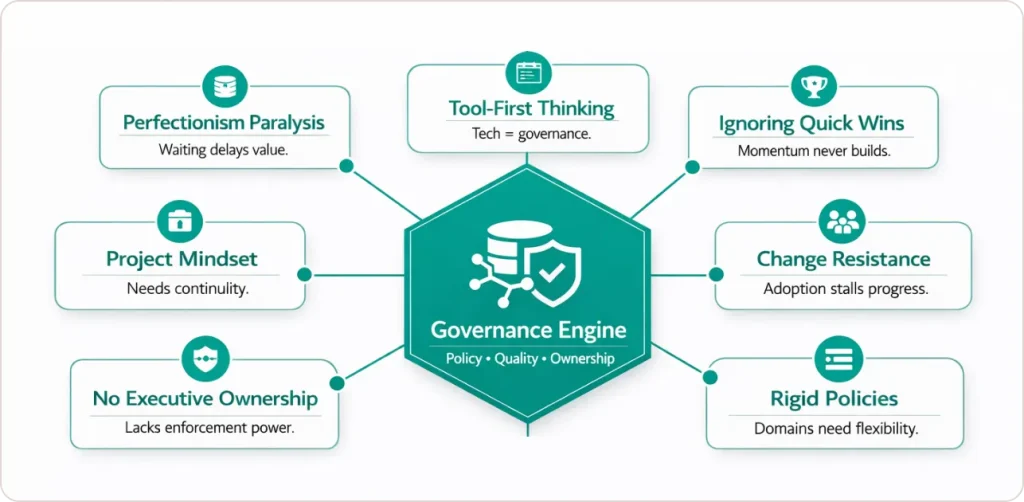
- Perfectionism paralysis. Don’t wait to catalog every dataset before launching. Start focused, improve continuously.
- Tool-first thinking. Buying a $500K catalog doesn’t create governance. I’ve seen organizations spend millions on technology while their program failed due to poor adoption.
- Ignoring quick wins. Broadcast early successes: “Our governance program reduced reporting errors by 67% in Q1, saving Finance 40 hours monthly.”
- Underestimating change management. Budget as much time for communication and training as for technology configuration.
- One-size-fits-all policies. Marketing data has different needs than financial data. Allow domain-specific variations within enterprise principles.
- No executive accountability. Without C-level sponsorship, your program will struggle to enforce decisions.
- Treating governance as a project. This is an operating capability requiring ongoing investment, not a 6-month initiative.
From Strategy to Measurable Impact
Building an effective data governance strategy in 2026 requires balancing technical rigor with organizational pragmatism. The 7-step framework – aligning with business goals, inventorying assets, assigning accountability, developing policies, implementing tools, monitoring continuously, and adapting for AI – provides a proven roadmap.
But the hard truth: governance is fundamentally about people, not technology. Success depends on executive sponsorship, stakeholder engagement, and demonstrating tangible value through quick wins.
Organizations thriving in 2026 treat data as a strategic asset, governed with the same discipline as financial controls. The $12.9 million annual cost of poor data quality makes inaction expensive. Escalating regulatory penalties make non-compliance riskier. AI initiatives fail without trustworthy foundations.
Leverage our data analytics consulting services to explore proven frameworks, implementation support, and change management guidance.