

TL;DR
- Global ecommerce is projected to exceed $7.4 trillion in 2026, but overall market growth is masking a decline in conversion rates across most mid-market brands.
- AI-referred traffic to ecommerce sites surged 1,247% in late 2025 (Signifyd), yet only 22% of shoppers have used AI search tools to find products. The infrastructure is ahead of consumer trust.
- TikTok Shop grew over 400% year over year and is projected to reach $23.4 billion in US GMV by the end of 2026, according to eMarketer.
- Brands that structure product content for AI parsing now hold a compounding advantage before agentic buying normalizes.
- This guide covers 10 ecommerce industry trends with data, action steps, and clear decisions, based on research from Signifyd, Salsify, Forrester, and eMarketer.
Quick Answer
Ecommerce trends in 2026 are defined by AI-mediated discovery, with AI-referred traffic surging 1,247% since late 2025. Social commerce has surpassed $1.2 trillion globally, and sustainability compliance through Digital Product Passports is reshaping how brands manage product data infrastructure.
Global ecommerce sales are projected to reach $7.41 trillion in 2026, while conversion rates remain highly variable across industries and channels.
The ecommerce trends driving that gap are not mysteries. AI is changing how products are discovered. Social platforms are replacing search as the entry point for an entire generation of buyers. And brands running fragmented channel stacks are losing customers they cannot even see leaving. What follows covers the shifts with actual revenue implications, backed by primary research, not recycled predictions.
What Is Agentic Commerce, and How Is It Changing Product Discovery Right Now?
Agentic commerce refers to AI systems that autonomously search, evaluate, and initiate purchases on behalf of a consumer, without requiring manual input at each step. In 2026, this is no longer speculative. It is already reshaping traffic patterns and conversion funnels across major ecommerce categories.
AI‑referred traffic to ecommerce sites surged 1,247% in late 2025, according to Signifyd’s 2026 State of Commerce (Ecommerce Trends) analysis, which tracks AI‑driven conversions across its merchant network. The infrastructure is scaling well ahead of consumer adoption, which means brands that build machine-readable product content now will hold a compounding advantage when autonomous purchases normalize.
The trust gap is the most useful strategic frame here. According to Signifyd, 63% of consumers are comfortable with AI searching for the best price on their behalf, but only 6% are willing to let an AI system complete the transaction without their approval. That 57-point gap is not a barrier. It is a window. Brands that invest in transparent data policies, secure checkout handoffs, and structured product specs now are building the infrastructure that closes that gap before competitors do.
Three actions to take immediately:
- Write product descriptions for AI parsing first, human readers second. Front-load specs, dimensions, certifications, and use-case language in the first 40 words of every product description.
- Treat Answer Engine Optimization (AEO) as a separate workstream from SEO. AI assistants surface recommendations based on how directly your content answers a specific question. A product page that answers “What is the weight limit?” in the first sentence outperforms one that buries the spec three scrolls down.
- Add AI-referred sessions as a tracked segment in your analytics. Referral sources labeled “chatgpt.com,” “perplexity.ai,” or Google AI Overviews in GA4 are already measurable. If you cannot see AI-driven traffic, you cannot optimize for it. Web analytics practice includes setting up this attribution layer as a standard first step for ecommerce clients.
Is Social Commerce a Real Revenue Channel in 2026, or Still a Brand Awareness Play?
Social commerce is a genuine, measurable sales channel in 2026. TikTok Shop grew over 400% year-over-year and is projected to reach $23.4 billion in US gross merchandise value by the end of 2026, according to eMarketer. According to Statista, 110 million Americans now shop directly through social platforms. That is not a niche behavior.
The most useful strategic framing for 2026 is this: TikTok creates demand. Amazon captures it. These platforms are not competing for the same moment in the purchase funnel. TikTok-driven impulse discovery and Amazon’s intent-based fulfillment serve different consumer states. Brands running coordinated strategies across both consistently outperform brands treating them as alternatives.
Livestream shopping is accelerating this split. US livestream ecommerce is expected to reach $68 billion by 2026, per TechDogs, with significantly higher engagement than static product pages. For beauty, apparel, and home goods, livestream is a primary sales driver.
According to Akeneo’s research on 2026 eCommerce trends, 43% of Gen Z consumers start their online shopping searches on TikTok, surpassing even Google and Amazon.
“Social platforms have become the new mall. The question is not whether to be there. It is whether you have the content infrastructure to convert attention into revenue.”
Guy Elliott, Global Head of Commerce, Publicis Sapient (source)
Measuring social commerce ROI accurately requires connecting platform-level conversion data to your broader revenue reporting. That is a channel attribution problem before it is a creative problem. Sales and marketing analytics practice helps ecommerce teams build unified attribution models that give social channels their accurate share of credit, rather than last-click distortion.
What Does Unified Commerce Actually Require, and Why Do Most Brands Get It Wrong?
Unified commerce means consolidating inventory, customer data, and order management into a single backend system that serves every channel simultaneously. It is distinct from multichannel retailing, where each channel runs its own data stack and the customer experience fragments at every handoff.
The practical failure mode is predictable. In a multichannel setup, your store, app, and marketplace listings may show different stock levels. A customer who buys online, returns in-store, and attempts a curbside pickup encounters three separate data systems pretending to be one experience. Most do not complain. They leave and do not return.
Salsify’s 2026 research reinforces where the gap costs most: 60% of shoppers still discover new brands in-store, and 51% use marketplaces like Amazon to research before buying elsewhere. The physical and digital touchpoints are not replacing each other. They are part of the same decision loop. Brands without a unified data layer are missing most of that loop entirely.
What unified commerce requires in practice:
- A single order management system (OMS) that syncs inventory across every channel in real time.
- A customer data platform (CDP) that stitches together behavior across in-store, app, and web into one customer profile.
- A product information management (PIM) system that ensures consistent specs, pricing, and media across every channel.
SR Analytics works with retail businesses to build the data infrastructure that makes unified commerce operationally real, not just strategically aspirational.
How Is Consumer Behavior Shifting in 2026, and What Does It Mean for Conversion?
Consumer behavior in 2026 is defined by value discipline. Price sensitivity is at a multi-year high: 72% of shoppers switched brands in the past year primarily due to price, according to Salsify’s 2026 Consumer Report. Shoppers are browsing less frequently but transacting more deliberately when they do.
Three behavioral patterns worth building a strategy around right now:
Secondhand and dupe markets are growing across categories. Consumers are actively seeking quality alternatives at lower price points. Brand equity alone is no longer enough to hold loyalty when a credible alternative exists at 60% of the price. Brands that do not acknowledge this in their positioning are losing ground to it.
Detailed product content is a direct conversion driver, not a nice-to-have. According to Salsify’s research, 31% of shoppers say detailed specifications, including dimensions, materials, and certifications, are the primary reason they complete a purchase they were previously uncertain about. Sparse product pages are a conversion liability with a measurable cost.
AI-powered recommendations are now a normal part of the shopping experience. According to Akeneo’s 2026 consumer survey, 49% of US shoppers already use AI-powered product recommendations in some form. Brands that feed accurate, structured data to those systems surface more often. Brands with incomplete data do not.
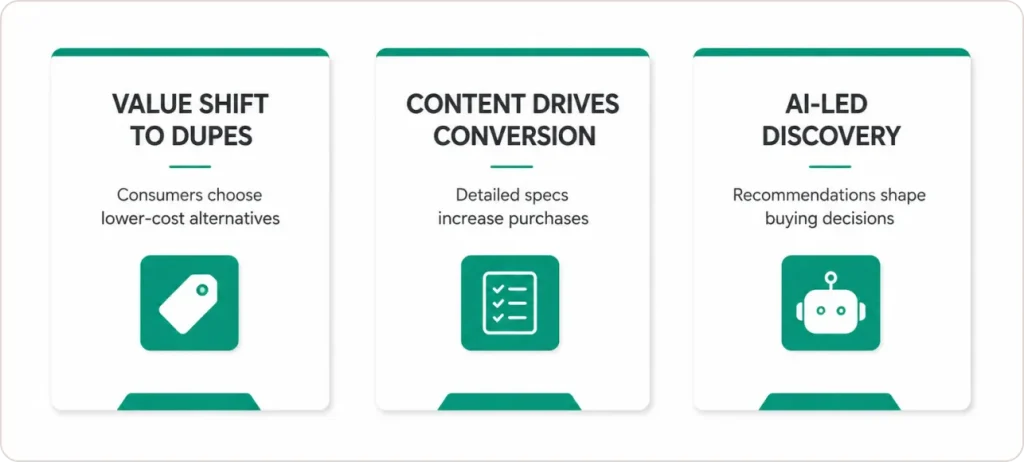
The pattern across all three shifts is identical: trust is built through specificity, not brand narrative. Buyers in 2026 are more skeptical, better informed, and more willing to switch than at any point in the previous five years.
What Are Digital Product Passports, and Do They Matter If You Are Not Selling in the EU?
A Digital Product Passport is a structured data record that accompanies a physical product from raw materials through end-of-life. It captures material composition, carbon footprint, supply chain traceability, and circularity instructions. Under the EU’s Ecodesign for Sustainable Products Regulation (ESPR), DPPs will be mandatory for textiles, electronics, and tires between 2026 and 2027.
For US-based brands with any EU exposure, this is already a compliance requirement, not a future consideration. The strategic case extends beyond compliance. According to PwC’s 2024 Global Consumer Insights Survey, consumers across every major market are increasingly willing to pay a premium for products with verified sustainability credentials. A DPP provides exactly that verification in a machine-readable, auditable format.
The implementation challenge is not branding. It is data infrastructure. Most brands currently lack a product information management system capable of storing and surfacing the granular data a DPP requires. Brands that complete a data gap analysis before technical standards are finalized in early 2026 will have a meaningful lead time advantage.
Five data fields every DPP must include:
- Material composition with percentage breakdowns
- Factory of origin and manufacturing process documentation
- Carbon footprint and Life Cycle Assessment data from verified methodologies
- Repair and maintenance instructions with authorized service partners
- End-of-life recycling and disassembly guidance
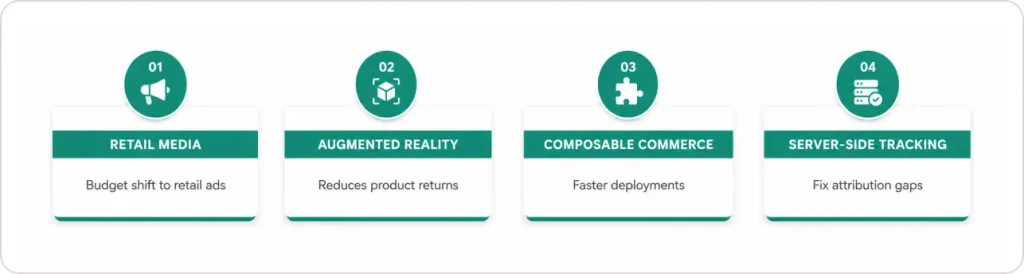
Brands already running a PIM system should audit it against these five fields immediately. Brands without one should treat DPP readiness as the business case for building that infrastructure now.
What Is Answer Engine Optimization, and Why Does It Now Matter as Much as SEO?
Answer Engine Optimization (AEO) is the practice of structuring content so AI systems, including Google AI Overviews, ChatGPT, Perplexity, and Grok, can extract and surface direct answers to user questions. It differs from traditional SEO in that ranking signals are based on answer specificity and self-containment in the first sentence of each section, rather than keyword density and backlinks alone.
A 2024 Gartner report on search behavior projected that AI‑powered answer engines will reduce traditional search engine volume by 25% by 2026 [MediaPost].
In ecommerce, AEO applies at both the content marketing and product page levels. An AI assistant asked, “What is the best running shoe for wide feet under $120?” It will surface product pages that answer that question directly in the first sentence, not pages that bury the relevant spec in a table at the bottom of the page. The brands winning AI-mediated discovery right now are not the ones with the largest content libraries. They are the ones with the most precisely structured answers.
This is also where generative AI solutions become operationally relevant for ecommerce teams. Scaling AEO-structured content across thousands of product pages is not a manual task. Brands using AI-assisted content pipelines are producing compliant, machine-readable product content at a fraction of the time cost.
How Should Brands Handle the $260 Billion Returns Problem?
Returns represent a $849.9 billion annual challenge in U.S. retail (including ecommerce), according to the National Retail Federation’s 2025 Retail Returns Landscape report. The gap between how leading brands handle returns and how most brands handle them is now a measurable competitive differentiator.
Tiered return policies based on customer lifetime value. High-value customers with a strong purchase history receive extended windows, label-free returns, or instant refunds. New or low-frequency customers receive standard policies. This protects the margin without degrading the experience for your best buyers.
Reverse logistics routing by disposition value. AI systems now route returned inventory to the highest-value outcome in real time: restocking, refurbishment, liquidation, or secondary market channels. Average revenue recovery on returned inventory increases 30% to 40% with intelligent routing versus default write-off.
Return policy as a conversion tool. A Salsify consumer study found that 44% of shoppers check a return policy before completing a first purchase from a new brand. The policy is part of the conversion funnel, not an operational afterthought.
What Are the Ecommerce Industry Signals Worth Watching in the Second Half of 2026?
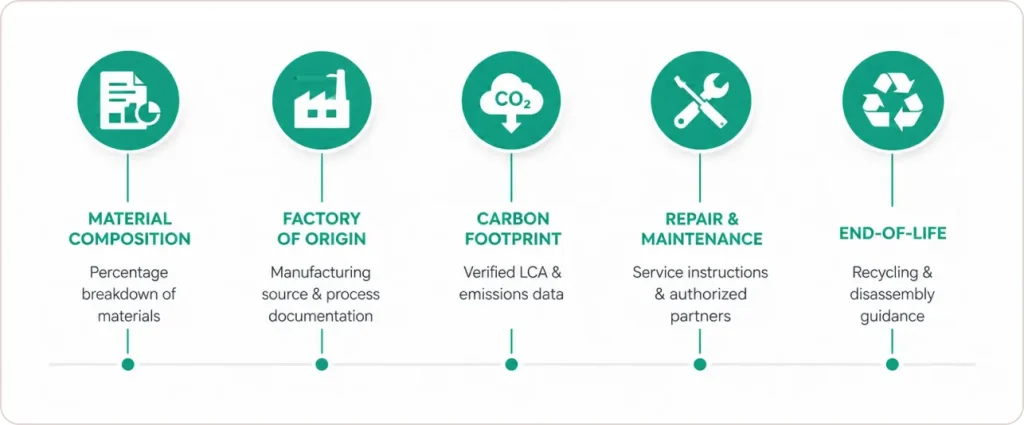
Four signals are tracking toward meaningful impact before year-end.
Retail media networks are moving budget at scale. Amazon, Walmart, and Target have built in-house ad platforms that now compete directly with Google and Meta for ecommerce advertising budgets. A 2024 Forrester report projected US retail media ad spending to exceed $61 billion by 2026. For brands selling through major retailers, this changes where media dollars go and how campaign performance is measured, and it creates a significant attribution problem for teams relying on platform-reported numbers.
Augmented reality is reducing returns in measurable categories. AR virtual try-on features in eyewear, furniture, and apparel are producing return rate reductions of 20% to 35% in documented case studies. Warby Parker’s virtual try-on reduced eyewear return rates by 23%, according to the company’s published results. The technology is now a margin protection tool, not a novelty.
Composable commerce is compressing time-to-market. Headless and composable architectures that decouple the frontend from the backend are enabling faster channel-specific experimentation. Brands making this shift report 40% to 60% faster deployment cycles for new storefront experiences.
Server-side tracking is becoming non-negotiable for attribution accuracy. Browser-level tracking restrictions from Safari and Firefox, combined with ongoing third-party cookie deprecation, have introduced significant data gaps in standard GA4 setups. Brands without server-side identity resolution in place are systematically undercounting paid channel conversions by 15% to 30%. This is a solvable problem, but only if it is diagnosed first.
Conclusion: What Should Ecommerce Teams Actually Prioritize in 2026?
Not every brand needs a TikTok Shop strategy this year. Not every operation selling in the US has EU customers requiring DPP compliance by 2027. But every ecommerce business is now affected by AI’s growing role in discovery, and that is the non-negotiable starting point regardless of category, size, or channel mix.
The ecommerce insights with the most consistent revenue impact across business types come down to three decisions:
Structure your product content for AI parsing. This is both an AEO and a conversion optimization move. The same content improvements that help AI systems surface your products also help human buyers make faster decisions. These two goals are no longer in tension.
Close the data gap between your channels. Whether through a full OMS and CDP implementation or a more targeted integration between your two highest-volume channels, unified data is the foundation on which every other trend in this list depends. Without it, you are optimizing in the dark.
Measure AI-referred traffic as a distinct segment. If you cannot see it, you cannot optimize for it. This is the single analytics change to make before anything else in 2026.
A 2024 Forrester report on commerce and data strategy found that brands with unified, cross‑channel data strategies outperform peers relying on fragmented operations in customer lifetime value and AI‑driven personalization.
If you want to understand where your current ecommerce data infrastructure has gaps before they cost you revenue, our team at SR Analytics is ready to help. We work with retail and ecommerce businesses to build the measurement foundation that makes every trend in this list actionable, not just readable.