

TL;DR
- Tail spend is 80% of procurement transactions but only 20% of total spend, making it the highest-volume, lowest-visibility cost problem in procurement.
- Unmanaged tail spend fuels maverick buying, supplier fragmentation, and hidden costs that compound every quarter.
- Organizations actively managing tail spend recover 5% to 10% in savings, with some exceeding 15%.
- Clean spend data is the prerequisite. Fragmented data kills tail spend programs before they generate a dollar.
Quick Answer
Tail spend management is the process of identifying, categorizing, and controlling low-value, high-volume purchases that fall outside strategic procurement programs. It reduces maverick spend, improves supplier compliance, and unlocks measurable cost savings across indirect procurement categories.
Before You Read Further: Three Questions That Reveal Your Problem
Most procurement leaders know tail spend is an issue. Few know how bad it actually is.
Can you pull a complete, transaction-level spend file from your ERP right now? Are supplier names normalized, or do you have fifteen variations of the same vendor in your system? Do category codes exist on at least 80% of your purchase orders?
If any answer is no, your tail spend problem is worse than your reporting shows. That data gap is the reason most tail spend programs fail before generating a single dollar in savings.
What Is Tail Spend, and Why Does It Keep Getting Ignored?
Tail spend is the large volume of low-value purchases that represent approximately 20% of total procurement spend but account for 80% or more of all procurement transactions. These purchases fall below the strategic sourcing threshold and, as a result, below the attention of most procurement teams.
The reason is not negligence. It is resource math. When a team has to choose between renegotiating a $10 million supplier contract and chasing a $2,000 cleaning service invoice, the $10 million contract wins every time. That logic is reasonable. It is also expensive when that invoice is one of 4,000 similar transactions occurring every quarter across the organization.
According to Deloitte, Tail spend is traditionally considered the weak link of spend management. This is mainly because purchases in the tail account for only one-fifth of total spend but constitute the vast majority of its volume.
Common tail spend categories include office and facilities supplies, MRO (maintenance, repair, and operations) parts, low-value IT accessories, marketing services from spot vendors, professional services purchased outside contract, and travel expenses routed through non-preferred suppliers. Individually small. Collectively, one of the most recoverable cost opportunities in your procurement portfolio.
One important risk that tail spend fragmentation accelerates is supplier vulnerability. When hundreds of unvetted vendors operate below procurement’s radar, the organization accumulates exposure that formal supply chain risk management programs are designed to prevent. Unmanaged tail spend and unmanaged supplier risk are, more often than not, the same problem.
What Is the Difference Between Tail Spend and Maverick Spend?
Tail spend and maverick spend are related but fundamentally different. Tail spend is a category defined by transaction value and volume. Maverick spend, also called rogue spend, is unauthorized purchasing that bypasses approved procurement channels entirely, regardless of dollar amount.
Maverick spend is a behavior. Tail spend is a category. The two overlap frequently because the low visibility around tail spend makes it easier for employees to buy outside approved processes without detection. When procurement policies are unclear or the approved buying path is slower than a direct vendor call, maverick spend grows. Tail spend is the environment that enables it.
Fixing them requires different interventions. Reducing tail spend volume requires supplier consolidation and category rationalization. Reducing maverick spend requires process design and buying channel compliance. Most organizations need both, in that order.
How Do You Build a Tail Spend Management Framework That Works?
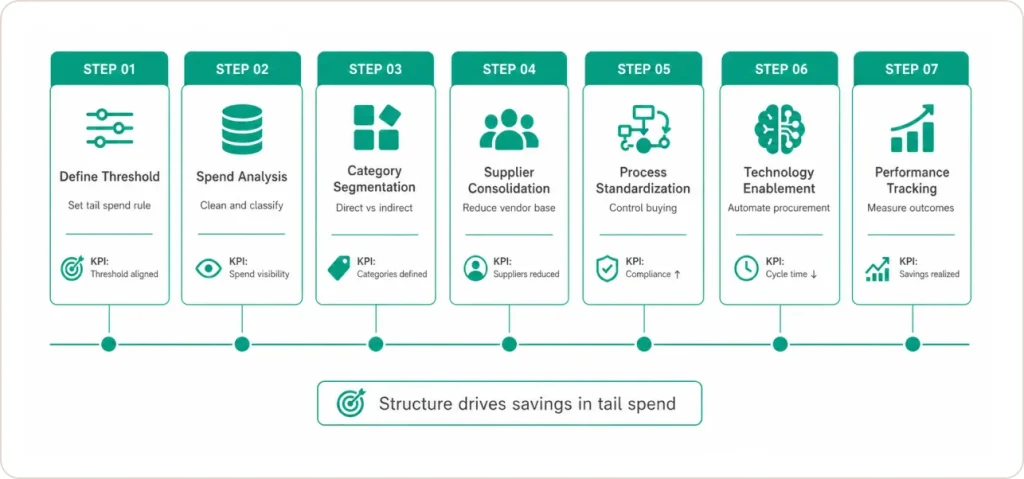
A tail spend management framework is a structured, repeatable process for identifying, categorizing, and controlling low-value procurement spend. Four pillars hold it up: spend visibility, supplier rationalization, process standardization, and technology enablement.
Step 1: Define your tail spend threshold. The Pareto principle is the most common starting point. Suppliers with less than $35,000 in annual purchases are often classified as tail spend, though some organizations define it by transaction frequency or category maturity. Pick a definition that finance and procurement agree on, then apply it consistently. Ambiguity here destroys alignment downstream.
Step 2: Run a spend analysis. Pull data from your ERP, P2P system, corporate cards, and expense reports. Cleanse it, normalize supplier names, and classify spend against a taxonomy like UNSPSC. This step is tedious. It is also where most organizations find their largest savings opportunities. Before building any model on top of this data, confirm your data is actually ready — the same principle that applies to predictive supply chain analytics applies here. Garbage in means garbage out, regardless of framework quality.
Step 3: Segment your tail spend categories. Separate direct tail spend, such as low-value components and emergency spot buys, from indirect tail spend, which covers MRO, IT peripherals, and marketing services. Each requires a different response. Direct tail spend responds to preferred supplier lists and blanket purchase orders. Indirect tail spend responds better to guided buying catalogs and vendor consolidation programs.
Step 4: Consolidate suppliers. If 400 suppliers collectively represent less than 5% of spend, consolidating that base to 80 preferred vendors gives your team real negotiating leverage and dramatically reduces the administrative cost of managing hundreds of low-value vendor relationships.
Step 5: Standardize the buying process. Pre-approved catalogs, centralized buying channels, and automated approval workflows make compliance the path of least resistance. When the approved option is the easiest option, employees follow the process without being forced into it.
Step 6: Enable the right technology. Modern tail spend management solutions automate purchase order creation, enforce policy at the point of purchase, and generate real-time spend visibility. AI-powered classification tools cleanse and categorize incoming spend data automatically, removing the manual overhead that has historically made tail spend management unsustainable at scale.
Step 7: Measure before you claim results. Define your baseline before launch. Track spend under management percentage, supplier count reduction, policy compliance rate, cost savings realized, and purchase cycle time. Review quarterly.
Tail Spend vs. Strategic Spend: What the Numbers Show
| Dimension | Tail Spend | Strategic Spend |
|---|---|---|
| Share of transactions | 70% to 80% of all POs | 20% to 30% of all POs |
| Share of total spend | 15% to 25% of budget | 75% to 85% of budget |
| Supplier count | Hundreds, often fragmented | Concentrated, preferred vendors |
| Policy compliance rate | Typically below 50% | Typically above 80% |
| Automation potential | High, 60%+ of transactions | Moderate, 20% to 30% |
| Primary risk | Maverick buying, fraud, data gaps | Supply disruption, price volatility |
| Savings lever | Consolidation and compliance | Negotiated pricing upfront |
Every characteristic that makes strategic spending manageable is reversed in the tail. That asymmetry is exactly why tail spend management requires its own framework, not a scaled-down version of strategic sourcing.
What Are the Main Challenges of Tail Spend Management?
Poor data visibility is the most common failure point. Hackett Group’s 2025 Tail Spend Management Study found 64% of procurement leaders are dissatisfied with tail spend management. Spend data lives across ERP systems, expense tools, corporate cards, and department purchasing accounts, often in incompatible formats. If your team cannot see where the spend is going, effective business intelligence dashboards built on top of unified procurement data become the practical starting point, not a luxury.
No internal ownership. Tail spend sits in a grey zone between procurement, finance, and department heads. Nobody owns it, so nobody manages it. Assigning accountability before defining the process is the first structural fix.
Low perceived strategic value. Because each transaction is individually small, procurement leaders allocate resources elsewhere. The aggregate cost only becomes visible after a formal spend analysis, which is precisely why that analysis must come first.
Employee resistance to new workflows. A procurement platform only works when employees use it. If the approved buying channel is slower or more confusing than a direct vendor call, adoption fails, and maverick spend continues.
Technology built for strategic sourcing, not tail spend. Most enterprise platforms optimize for high-value contract management and are not designed for the transaction volume and data messiness of tail spend. The right tail spend management solutions must handle scale without creating overhead that makes programs collapse.
What Are the Real Benefits of Controlling Tail Spend?
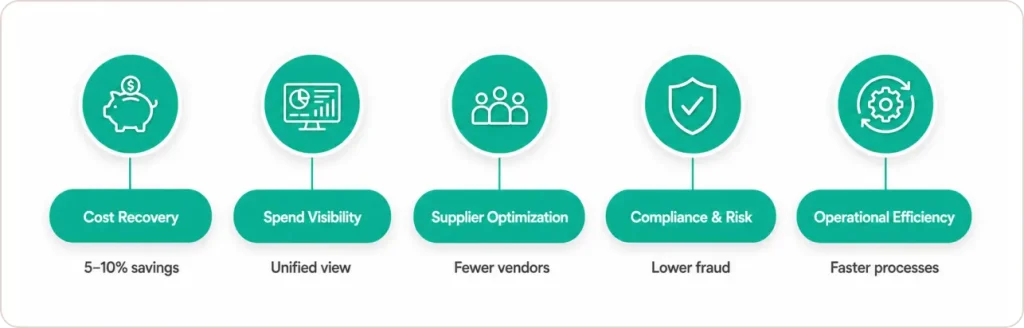
Cost recovery. According to Boston Consulting Group, firms that use digital to manage tail spend can cut their annual expenditures by 5% to 10%, on average, with some exceeding 15% when starting from low‑compliance baselines (Boston Consulting Group, ‘Taming Tail Spend’, 2019).
Spend visibility. Centralized procurement creates a unified transaction record that supports accurate budget forecasting, real-time financial reporting, and supplier benchmarking.
Supplier rationalization. Reducing redundant vendors strengthens preferred supplier relationships, improves payment terms over time, and reduces exposure to unvetted third parties, including ESG and sustainability compliance risks increasingly tied to procurement policy.
Compliance and fraud reduction. Cleaner supplier data removes duplicate and obsolete vendor records that create fraud vulnerability. The organizations with the lowest maverick spend rates consistently have the simplest, clearest buying processes.
Operational efficiency. Automating purchase order creation, invoice matching, and approval routing returns measurable time to procurement teams for higher-value work.
Managing tail spend is not a procurement housekeeping exercise. It is one of the highest-return interventions available to a CFO looking for margin improvement without cutting headcount.” Ardent Partners, State of Procurement Report Series
How Is Tail Spend Different in Retail and CPG?
Retail tail spend management and CPG tail spend management share the same root cause but manifest differently, and treating them identically produces weak results.
In retail, tail spend concentrates in store operations at scale: fixtures, consumables, seasonal display materials, and local maintenance services. A single store manager ordering from a local supplier instead of the approved vendor is a small compliance failure. Multiplied across 500 locations, it is a material budget problem. Retail analytics that surface spend compliance by location make this visible.
Fixing it requires location-level buying guides embedded directly into the purchase workflow. For retail teams already investing in retail demand forecasting, layering tail spend controls on top of that data infrastructure is a natural and cost-effective extension.
In CPG, the category boundaries are blurrier. Packaging samples, point-of-sale materials, contract manufacturing spot buys, and agency services purchased outside master agreements are all typical CPG tail spend categories. The risk is not just cost. It is brand consistency, regulatory alignment, and labeling compliance across supplier relationships that were never formally onboarded. CPG companies managing dozens of markets face this problem at scale.
The same AI capabilities driving results in AI in CPG transformations are increasingly applied to supplier spend monitoring and tail spend classification. SR Analytics works with CPG teams to build the supplier performance monitoring and spend visibility infrastructure that makes tail spend compliance measurable across markets, not just visible in an annual audit.
What Should You Look for in Tail Spend Management Solutions?
Gartner estimates that by 2030, approximately 60% of procurement organizations will adopt tail‑spend technology solutions to drive cost management, risk mitigation, and sustainability compliance. That adoption is already accelerating in 2026.
When evaluating tail spend management solutions, focus on three questions. Can the platform ingest spend data from all your source systems automatically? Does it classify and enrich that spend data without manual intervention? Does it enforce buying policy at the point of purchase rather than after the fact?
Beyond those essentials, look for guided buying catalogs, real-time spend dashboards with compliance flagging, supplier deduplication tools, and approval workflow automation that creates an audit trail without adding friction. The platform employees actually adopt will always outperform the platform with the most features they route around.
Selecting a platform is only one part of the decision. The more important decision is how you build the analytical layer that sits on top of it. A strong data strategy roadmap determines whether your tail spend program generates insight for one team or scales into an enterprise-wide spend intelligence capability.
Conclusion: This Is a Margin Problem, Not a Housekeeping Exercise
The organizations winning on tail spend in 2026 share one characteristic. They stopped treating it as a cleanup exercise and started treating it as a recurring source of recoverable margin that compounds every quarter it goes unaddressed.
The math is not complicated. If your organization spends $200 million annually on procurement, tail spend likely represents $40 million or more. A 10% recovery rate on that figure is $4 million back to the business. That is a CFO-level outcome, not a procurement department project.
The path to that outcome runs through clean spend data, a structured tail spend management framework, supplier consolidation, and buying channels that make compliance the default. The technology exists. The frameworks are proven. The variable is whether your organization treats data readiness as the starting point rather than an afterthought.