
TL;DR
- Databricks is an open Lakehouse platform used by over 60% of the Fortune 500 for data engineering, machine learning, real-time streaming, and governed AI applications on customer-owned cloud storage.
- AT&T reduced fraud by 70-80% and Travelpass cut cloud spend by 65% after consolidating fragmented data stacks onto the platform.
- Virgin Australia deployed ML models 90% faster and reduced lost baggage by 44% using Databricks’ managed MLflow environment.
- The biggest ROI driver is rarely faster queries. It is eliminating the coordination overhead between engineering, data science, and analytics teams that siloed architectures force on every organisation.
- This post breaks down the six use cases where Databricks delivers the most verified business value in 2026, including where it outperforms alternatives and where a combined architecture makes more sense.
Quick Answer
Databricks is an open Lakehouse data platform used by over 60% of the Fortune 500 for large-scale data engineering, machine learning lifecycle management, real-time streaming, and governed AI applications on customer-owned cloud storage via Delta Lake and Apache Spark.
Why Do Data Teams Keep Choosing Databricks Over Standalone Warehouses?
Databricks solves a structural problem that siloed data stacks create at scale: the fragmentation tax. Raw files live in an unmanaged data lake, processed tables sit in a proprietary warehouse, and machine learning experiments run on a separate compute cluster. Teams lose hours daily moving data between systems. Every handoff introduces latency, inconsistency, and security exposure.
The Databricks Data Intelligence Platform collapses that fragmented architecture into a single governed layer. Engineers, data scientists, and business analysts work on the same tables, governed by the same permission model, on the same compute fabric.
After reviewing enterprise migration outcomes across multiple client environments, the consistent finding is this: the biggest productivity gains come not from faster query execution but from eliminating the coordination overhead between teams that fragmented toolchains impose. That is a structural cost most total cost of ownership calculations never capture.
AT&T and Travelpass are not edge cases. Their results reflect what happens when an organisation stops paying the fragmentation tax and starts treating data as a single governed asset.
What Is the Mission of Databricks and Why Does It Matter for Platform Selection?
Databricks’ mission is to help data teams solve the world’s toughest problems by making data and AI accessible to every organisation. In architectural terms, that means one specific commitment: enterprise-grade AI and analytics without forcing a choice between the flexibility of open file formats and the reliability of a managed warehouse.
That mission distinction matters for platform selection. Databricks stores data in open formats (Delta Lake, Apache Iceberg) in the customer’s own cloud storage account. Snowflake stores data in proprietary formats in Snowflake-managed infrastructure. The choice has long-term implications for vendor lock-in, cost structure, and multi-cloud portability that procurement teams frequently underestimate at the evaluation stage.
The 2026 State of Modern Data Architecture Benchmark Report notes that organisations running open-format architectures report significantly lower migration costs when changing cloud providers compared to those locked into proprietary storage formats, making the open Lakehouse model a material financial consideration beyond its technical merits.
What Are the Six Databricks Use Cases That Drive Verified Business Outcomes in 2026?
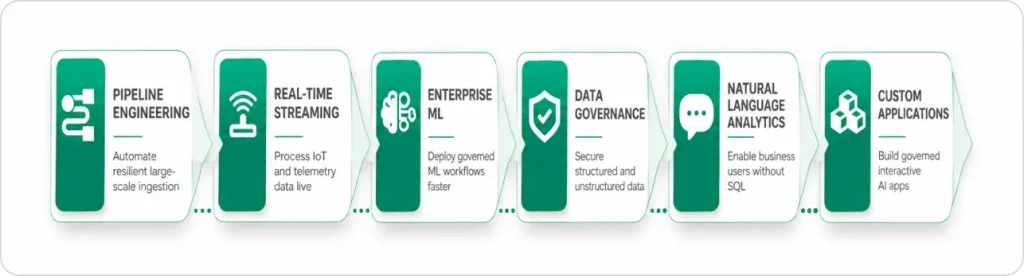
1. Is Databricks Good for Large-Scale Pipeline Engineering?
Yes. Databricks is purpose-built for pipeline processing billions of records across heterogeneous source systems. Delta Live Tables automates schema evolution and handles ACID-compliant incremental ingestion, so pipelines no longer break when an upstream API adds, removes, or renames a column.
Auto Loader monitors cloud storage continuously and ingests new files with exactly-once guarantees, meaning each record is processed precisely once even during failures or retries. For organisations managing hundreds of data sources, this removes the manual schema-patching work that consumes significant engineering capacity on every sprint.
Unilever’s “Blueprint” metadata framework achieved a 10x increase in pipeline development velocity across its Lakehouse environment using this approach.
If a data engineering team is spending more than 20% of sprint capacity on pipeline maintenance rather than new capability development, Delta Live Tables and Auto Loader directly address that drain. Teams building or rebuilding pipeline infrastructure can find the relevant implementation approach in data engineering services.
2. Can Databricks Handle Real-Time Streaming and IoT Sensor Data?
Yes, without requiring a separate streaming infrastructure layer. Databricks uses Spark Structured Streaming to ingest high-velocity data from IoT devices, clickstreams, financial tick feeds, and manufacturing sensors natively within the same platform.
For non-engineers evaluating this capability: Spark Structured Streaming processes data in micro-batches as it arrives, applies windowed aggregations such as average temperature per device every five minutes, and writes results to govern Delta tables. The entire pipeline runs inside Databricks with no separate stream processor and no additional infrastructure to provision or maintain.
Eneco replaced an expensive on-premises Hadoop cluster by deploying this streaming architecture to process petabytes of real-time telemetry from smart household devices through its Toon application. The operational cost reduction and maintenance simplification were the primary drivers.
Rolls-Royce Civil Aerospace uses the same approach to continuously ingest telemetry from jet engines in commercial service, enabling predictive maintenance at fleet scale.
3. What Makes Databricks the Strongest Platform for Enterprise Machine Learning in 2026?
Databricks integrates managed MLflow natively, which means model versioning, experiment tracking, and artifact management run inside the same governed environment where training executes. No separate MLOps toolchain. No credential-sharing between systems. No manual handoff between the training environment and the model registry.
Teams run distributed hyperparameter optimisation across auto-scaling GPU clusters. Model promotion from staging to production uses the MLflow Model Registry with approval workflows that generate the audit trails compliance teams require.
The single biggest bottleneck in enterprise ML is not training performance. It is the gap between a model that works in a notebook and a model that runs reliably in production with version control, rollback capability, and a documented approval chain. MLflow’s registry closes that gap with the kind of governance record that satisfies both engineering teams and compliance reviewers.
Virgin Australia reduced ML model deployment timelines by 90% and cut lost baggage by 44% after standardizing on the Databricks Data Intelligence Platform. That outcome was not driven by faster training — it was driven by removing the friction between experimentation and production deployment using MLflow and Unity Catalog (Source).
According to Forrester’s December 2025 research on AI governance gaps, 62% of enterprises face widening AI governance gaps that create operational and security risks as AI adoption accelerates.
Organisations assessing ML readiness will find data science consulting services relevant for both initial capability building and MLOps maturity improvements.
4. How Does Databricks Handle Unstructured Data Governance at Scale?
Unity Catalog Volumes let organisations store, govern, and audit unstructured files including medical images, PDFs, audio recordings, and video, alongside structured Delta tables, under the same permission model and the same audit log. External computer systems access those files through credential vending APIs that issue temporary, scoped tokens rather than requiring persistent cloud storage credentials with broad access.
This matters because unstructured data is where most governance frameworks break down. Structured tables get row-level security and column masking. Raw files in cloud storage frequently get a single shared service account with no user-level attribution, no expiry, and no audit trail. Unity Catalog Volumes close that gap.
AXA France unified 200 TB of data from 54 data sources onto a single Databricks Data Intelligence Platform (Lakehouse), enabling personalized insurance services for over 6.3 million customers. Since the migration, 20x more users now have easy access to data, and they cut total cost of ownership in half (Source).
Financial services and healthcare organisations facing similar regulatory mandates will find the compliance architecture patterns relevant. Financial services analytics practice and fraud detection and risk management solutions both apply this governed data layer to regulated industry workloads.
5. How Does Databricks Enable Business Users to Query Data Without SQL?
Databricks Genie is a natural language interface that lets business users type plain English questions against curated, governed data tables. The system translates those questions into validated SQL, executes them against the appropriate dataset, and returns results without exposing raw schema details or requiring the user to know any query language.
This matters because ad-hoc query requests from business stakeholders are one of the most consistent and underreported sources of data engineering capacity loss. Every “can you just pull this number for me?” request that routes through the engineering queue represents engineering time that cannot be spent on pipeline development or model improvement.
Ticketmaster deployed a Genie-equivalent conversational system called “OMT Wizard” to over 500 operational users and documented savings of more than 8 weeks of manual query execution per year. Coop deployed “AskCap” via Microsoft Teams for category managers querying complex sales matrices in plain language, achieving a 30% monthly active user retention rate.
6. Can Development Teams Build and Deploy Custom Applications Directly on Databricks?
Yes. Databricks Apps allows developers to deploy interactive Python applications built with Streamlit, Gradio, Dash, or FastAPI directly inside the governed Databricks environment. There is no separate hosting infrastructure to configure and no data movement risk from copying governed tables to an external application server.
This closes a real capability gap that static BI dashboards cannot address. Dashboards display what the data says. Applications let users interact with the data: run what-if cash flow projections against live financial tables, annotate employee performance scorecards with qualitative context, or trigger ML model inference on demand. These scenarios require write-back, interactivity, and stateful sessions that reporting tools are not designed to support.
SAE International converted a generative AI RAG proof-of-concept into a production-ready enterprise application using Databricks Apps without managing any external hosting infrastructure. The security perimeter of the application is the same as the security perimeter of the data, because the application runs inside it.
Organisations building internal AI tools on top of governed data will find generative AI consulting services directly applicable, particularly for teams converting notebook experiments into governed, production-ready AI applications.
How Does Databricks Compare to Snowflake for These Use Cases?
Both platforms are actively expanding into each other’s territory in 2026. The architectural foundations remain genuinely different for specific workload types, and those differences have practical implications for teams choosing between them or designing a combined stack.
| Dimension | Databricks | Snowflake |
|---|---|---|
| Core design | Open Lakehouse on customer-owned cloud storage | SaaS cloud data warehouse on Snowflake-managed storage |
| Storage format | Delta Lake, Apache Iceberg, UniForm (open formats) | Proprietary (external Iceberg table support available) |
| ML and AI workloads | Native MLflow, GPU clusters, Mosaic AI (purpose-built) | Snowpark ML (actively developing, lighter ML support) |
| Streaming ingestion | Spark Structured Streaming, native and mature | Snowpipe Streaming (significantly improved in 2025-2026) |
| High-concurrency SQL | Strong via Photon C++ engine | Purpose-built for short concurrent queries |
| Governance model | Unity Catalog: multi-cloud, cross-workspace, unified | Native RBAC: robust within single Snowflake account |
| Vendor lock-in risk | Low (data stays in customer storage in open formats) | Moderate (proprietary storage format by default) |
| Best primary fit | ETL at scale, ML lifecycle, streaming, AI applications | High-concurrency SQL reporting, BI, structured data sharing |
The table reflects platform capabilities as of May 2026. Both platforms release features on continuous cycles.
Many mid-to-large enterprises run both platforms deliberately: Databricks handles raw ingestion, complex transformation, and ML model training, then promotes structured Gold-layer tables to Snowflake for downstream business reporting and BI. This coexistence architecture is not a compromise. For organisations with mixed workload profiles, it is frequently the optimal design.
What Do Independent Analysts Say About Databricks in 2026?
Independent validation from outside the vendor’s own marketing is the right calibration point for enterprise procurement decisions.
According to BARC’s The Data Fabric Survey 2026, practitioners rated Databricks 8.6/10 for performance, 8.3/10 for platform reliability, and 8.3/10 for scalability in enterprise production deployments.
A commissioned Forrester Total Economic Impact study of Databricks reported a composite 417% ROI over three years, with value driven by lower infrastructure costs from platform consolidation and faster time-to-insight for analysts.
Gartner named Databricks a Leader in its 2025 Magic Quadrant for Data Science and Machine Learning Platforms, citing end-to-end ML lifecycle management and open-source tooling integration as differentiating factors from proprietary competitors.
“Unified data and AI platforms are no longer a future-state architecture. Organisations still operating separate ingestion, transformation, and ML layers are carrying compounding integration debt that grows with every new data source they add.” — Sanjeev Mohan, Principal Analyst, SanjMo Research, sanjmo.com
What Do Databricks Use Cases Look Like in a Data-as-a-Service Architecture?
When organisations move toward data-as-a-service models, where data is treated as a product delivered to internal or external consumers with defined SLAs, Databricks functions as the governed data product layer.
Delta Sharing enables live, read-only data exchange across organisational boundaries without duplicating files or building custom APIs. A supplier shares a Delta table with a retail partner’s analytics team using credential-scoped, read-only access. The partner queries live data. The supplier retains full governance, audit logging, and revocation control.
This pattern increasingly replaces manual file-transfer workflows and point-to-point ETL pipelines between business partners. For retail organisations implementing this model, SR Analytics’ retail industry analytics practice covers the data product architecture patterns that enable governed supplier and partner data exchange at scale.
What Are the Right Next Steps for Teams Evaluating Databricks in 2026?
Organisations that extract the most value from Databricks before starting share three characteristics: a clear inventory of current fragmentation costs across their data stack, at least one defined workload that requires capabilities beyond a traditional SQL warehouse, and a governance requirement that centralises rather than multiplies access control points.
If the engineering team is spending sprint capacity on pipeline maintenance instead of new capability development, if ML models are failing to reach production reliably, or if business stakeholders are routing constant ad-hoc query requests through the data team queue, those are the three most common and most measurable signal points. Each is directly addressable with capabilities that exist in the platform today.
The outcomes cited throughout this post are not outliers. AT&T’s 70-80% fraud reduction, Virgin Australia’s 90% faster model deployment, and Travelpass’s 65% cloud spend reduction reflect workloads structurally similar to what most mid-to-large data teams operate. The variable is not the technology. It is whether the architecture is designed to support it.